
Where Historical Fiction Shines
As happens with most things in life, historical fiction excels at some tasks and performs less well at others. As a historian by training, I don’t try to convince myself that any novel I produce can reflect the past with 100% accuracy. That’s barely possible in works focused on the present day, since each of us has a unique perspective on the world around us—defined by family background, political and/or religious affiliation, place of birth and current residence, and simply individual preferences and traits.
But writing about the present gives at least the illusion that we know what we’re talking about. Sights, sounds, smells, tastes, sensations of all sorts—these things we can experience in real time, recording our own experiences onto the page. Move back even a century, and that’s no longer true. Move back five centuries, as I do every time I sit down to write, and I’m asking more questions than I can answer. The main appeal of a time machine—for me—would be the opportunity to find out what a Moscow street smelled and sounded like in 1550 or how it felt to race on horseback over the feather grass. How does it change the way a person experiences the world to live in a house with windows you can’t see through? What’s it like to don clothes so complicated you can’t dress yourself without help?
Even for historians, accuracy can hang tantalizingly out of reach due to absence of documentation or conflicting accounts (things not unfamiliar even in the modern world but less often encountered now than in the study of Ivan the Terrible’s Russia or even Henry VII’s England). That said, writing about the past does offer one huge advantage, especially to the novelist: most often, no one else knows what that London street smelled like either. And when detailed information goes missing, that’s where historical fiction finds its wings.
It’s also where the fun begins. I don’t want to say much yet, as this project has so far not gone beyond the “glimmer of an idea” stage, but I stumbled across a single line in a letter that hints at a fascinating story. It certainly has some basis in fact, but it’s the kind of thing that drives my historian brain nuts: there’s no proof of anything (at least, no proof I’ve found so far, although I’ve barely started looking) beyond the letter itself. But my novelist brain is having a field day imagining the possibilities: an entire life, previously unknown to me, expressed in that one line and perhaps in a dozen or so other notations that could refer to the same person or to someone else entirely.
And that’s both the beauty and the strength of historical fiction: it frees the mind to consider how those pieces might fit together, given the circumstances of a particular time and place—or, in this case, at least three places.
As I work it out, I will still, of course, strive to keep settings, characters, and even the plot as close as possible to what I know about the sixteenth century. But the opportunity to play with alternate explanations of the scarce information available, to consider what a particular setting would mean to a person who began life in a very different world—that’s something I can’t get from writing academic history. And it’s precisely what I love about immersing myself in the fictionalized past.
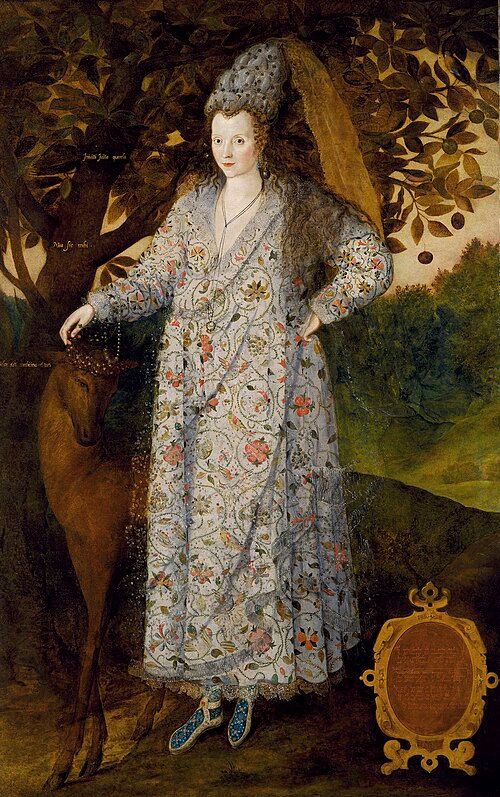
Above is an image that may—or may not—represent the main character of my standalone novel-to-be.
Image: Marcus Gheeraerts the Younger, Portrait of an Unknown Woman, 1590s; public domain via Wikimedia Commons.


