Once a Historian
I teased earlier this year about a standalone novel I’ve been considering writing between Song of the Silk Weaver (Songs of Steppe & Forest 7), now awaiting one more run-through before it moves to the publication stage, and Song of the Sleuth (Songs of Steppe & Forest 8), currently an almost-complete if very messy and all-over-the-place first draft. It’s important to get the general outlines of those two worked out, since they involve many of the same characters, so the details need to align. But once I’m certain that the main pieces are in place, Song of the Sleuth can ferment quietly in a corner while I activate the historian side of my brain in plotting out the standalone, tentatively titled Catch a Falling Star.

My historian side never really goes to sleep, of course. Once a historian, always a historian. History was my first love among academic disciplines, the place where I immediately felt at home, and that determined the course of my career long before I started writing fiction, more or less on a whim. Even then, as soon as I got the obligatory first dreadful novel (it improved over time) out of my head, I began thinking about how to turn my love of history—medieval Russian history, in particular—into fictional portrayals. Legends of the Five Directions and the current Songs of Steppe & Forest novels grew directly out of that decision.
The new novel springs from the same root, but it moves in a slightly different direction. As I was checking some dates for Anthony Jenkinson’s (English merchant/explorer, familiar to every historian of sixteenth- and seventeenth-century Russia because of his remarkable travelogues, but apparently no longer a household name for the citizens of his homeland) four journeys to Moscow—on Wikipedia, because I needed only a quick refresher—I discovered a reference to a person I had not encountered in all my decades of studying Muscovy.
According to Wikipedia (but read on), Jenkinson purchased a young woman named Aura Soltana and brought her back to England after his first voyage to Russia, which ended in June 1560. This young woman now has her own Wikipedia page, which links her to one of Queen Elizabeth I’s gentlewomen of the court, Ippolyta or Ipolyta the Tartarian.
As a novelist, I couldn’t resist. What must it have been like for Aura/Ippolyta to leave the grasslands of Central Asia for the Tudor court in London? I started poking around, and the more I investigated, the more my historian’s brain kicked in, assessing the sources (mostly credible, since they take the form of entries in account books) and arguments (often far-fetched). In the end, I concluded that fiction was the only way to handle this story, since the sources are so sketchy and many of the conclusions unprovable. But I’m still having a lot of fun figuring it out.
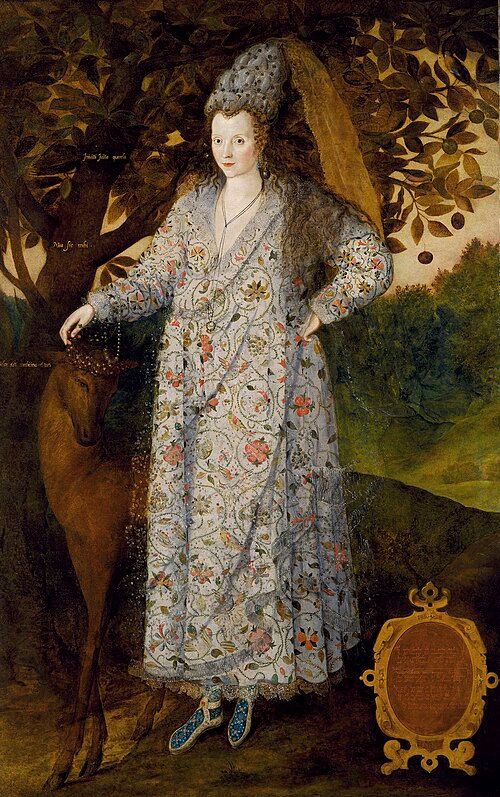
To give but one example, the first painting that illustrates this post is attributed to a painter named Marcus Gheeraerts the Younger and tentatively dated to 1595. For centuries, it was considered to be a portrait of Elizabeth I herself—possibly pregnant, although that says more about the spectators than the subject, by then in her sixties. Now it’s “Portrait of an unknown woman in masque costume, associated with Aura Soltana, 1590s.”

Now, Turks and Tatars, either in the sixteenth century or today, are not always dark-haired and dark-eyed. And the robes this woman is wearing are definitely Turkic in style. The hat, in particular, resembles the saukele still worn by Kazakh brides. Yet I took one look at this painting and thought, That looks like Elizabeth Tudor to me. I compared it with other portraits of her late in life (by then, there was an approved way to portray the queen, who wanted to appear young and vibrant in part because her health symbolized the status of her realm), and it still looked just like Elizabeth, albeit in a somewhat less flattering portrayal than usual. But that was Gheeraerts’s style, as can be seen from other paintings he did of Elizabeth in her fifties and sixties.
I began digging into historical studies of Elizabeth’s court, looking for any hard evidence I could find of Aura Soltana (one reference by Jenkinson, with a marginal note by the sixteenth-century editor, Richard Hakluyt, that “This was a Tartar girl he gave to the queen afterward”) or Ippolyta the Tartarian (short, mostly annual notations in official records). Most useful in the first round was Heather Shanette’s Elizabeth’s Ladies, Gentlewomen, and Maids: The Women Who Served the Tudor Queen (Pen & Sword History, 2025), where I discovered that Ippolyta appears in the court records from May 1561 until New Year’s 1576, when she is listed as “late”—interpreted as deceased, although other Tudor sources I checked suggest it may also have meant “former” at the time. Either way, she was probably not around when Gheeraerts painted “her” portrait. But then, where did Elizabeth get those clothes?

This week, I found what I think is the answer. Reading another historical study, The Sultan and the Queen by Jerry Brotton (Penguin, 2016), I found a reference to gifts sent to Elizabeth by Safiye, the Valide Sultan and hence most powerful woman in the Ottoman Empire. They reached London in August 1594 and included “an upper gown of cloth of gold very rich, an under gown of cloth of silver, and a girdle of Turkey work, rich and fair.”
No mention of a hat, but the style of the one that Elizabeth—if it is Elizabeth, and I think it must be—wears in the portrait matches not only today’s Kazakh saukele but the typical headdress of a sixteenth-century Ottoman empress, as can be seen from a painting of Sultan Suleiman’s wife, Hürrem Sultan, attributed to Titian (1485–1576), and an eighteenth-century imagining of Safiye Sultan herself by an unknown artist. Neither of these was done from life, but they do reflect the general style of Ottoman imperial fashion in the mid- to late sixteenth century.

But whatever the inspiration for the hat, from the description, the robe could well be the one sent from Constantinople and received in 1594. The timing of the painting lines up, too. Not conclusive, of course, but more convincing than the attribution to a Tatar woman who undoubtedly existed but about whom little information has come down to the present.
If nothing else, I love letting my historian self loose on the evidence, and I expect to enjoy fictionalizing it even more—especially since in a novel, I have no obligation to kill off my Arasultan (my best guess at the original version of my heroine’s mangled name) just because somewhere a record book refers to her as “late.”
Images: Marcus Gheeraerts the Younger, Portrait of an Unknown Woman (once believed to have been Queen Elizabeth I), ca. 1595; unknown Flemish artist, the Darnley Portrait [of Elizabeth I] (c. 1575); Titian, La Sultana Rossa (c. 1550), unknown artist, Valide Safiye Sultan (1700s)—all public domain via Wikimedia Commons.